I hope it’s not unbecoming if I express, in some small but public way, my basic intention with Songs Only You Know:
Writing the book was an ongoing attempt to push deeper into the past, to see it anew, in all of its complexity, with as much clarity as I could manage. The process took five years, and I worked on it constantly. I needed to understand how and why my family’s story unraveled as it did, and to feel—through an aesthetic process—what it was like to stare into some difficult memories, things I couldn’t otherwise face. I also wanted to communicate, to try to convey to someone else the purest senses I could of some of how certain experiences felt, what they looked like, and the intensity of their effects. My hope was that, if I wrote well enough—with all of my love for books and language and for the people I was characterizing—there would be readers out there, somewhere, who’d be glad this book existed. I had not, though, until very recently, had a true idea of how overwhelming it is to offer a story like this to friends and relatives and old neighbors, to whomever in the world might choose to pick it up.
My book contains, from a literary standpoint, a plentiful amount of characters and spans a considerable amount of narrative time, about ten years. It was artistically impossible to account for all of the people in my life, let alone my family’s life, their friends and extended families. There were people present during those years who were exceptionally gracious to us, and there were, also, placid times. There were also problems beyond those of my immediate family, things of a magnitude it would have been coarse to mention as passing details. My book is told from the perspective of a very young man who was processing his trauma in real-time, sometimes in a colorful way. Those experiences were the ones I felt most compelled to write about and I attempted to do that with honesty.
My truest explanation is: it was something I had to do. And as Philip Roth, quoting Joe Louis, recently said, “I did the best I could with what I had.”
Sincerely,
Sean
04.25.14
I’m not sure I’ve ever felt so much gratitude, all at once, for the kindness and generosity of the people in my life. The support I’ve received around the publication of this book is truly humbling—it’s almost overwhelming. I hope to spread this feeling.
The interview with the psychoanalyst and writer Adam Phillips in the latest Paris Review (208) has been a gift this week, so much brilliance in so few pages:
The Leavisite position, more or less, is that reading certain sentences makes you more alive and a morally better person, and that those two things go together. It seems to me that that isn’t necessarily so, but what is clear is that there are powerful unconscious evocative effects in reading books that one loves. There’s something about these books that we want to go on thinking about, that matters to us. They’re not just fetishes that we use to fill gaps. They are like recurring dreams we can’t help thinking about.
—A. Phillips.
8th Ave
http://www.youtube.com/watch?v=DWks6QsbEtU
It would be a mistake to remark only on the fact that this man has one of the truest, deepest, most inimitable voices in the history of recorded music—because, watching this video, Howlin Wolf’s entire spirit is on display, in all of its physicality, channeling something only he can. Functionally illiterate at the time of this performance, words come through him as though he’s pulling them from the dirt—root and all—wringing out new sensations, desires that go deeper than we’re able to truly appreciate, a poetry you can marvel at but never own. In his estimation, “Any time you thinkin’ evil, you thinkin’ about the blues.”
04.13.14
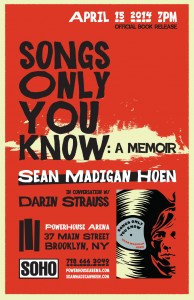
Dan Jaquint designed this poster… a slight nod to Saul Bass.
—————————————
“I have come to believe that language, a line of print, say, is capable of inhabiting the imagination far more intensely than any picture, however doctored. Descriptive language supplies deeper penetration, attaches itself to the rods and cones of interior perception, to a greater degree than a recovered or remembered image. Language is the process that lashes experience to the intellect.” —Robert Stone, Prime Green
—————————————

03.14.14
Digital Dispatch: Songs Only You Know (loop)
——————
(Jan 12): Seek, Denis Johnson; The Flamethrowers, Rachel Kushner; A Flag for Sunrise, Robert Stone; The Cloud Corporation, Timothy Donnelly.
——————

Return to Beggar
——————
Reading (Dec. 10): The Names, Don Delillo (second reading); Paris Review issues 203 and 207; Light Years, James Salter.
——————
Reading (Nov. 22): Harvest, Jim Crace; We’re Flying, Peter Stamm
——————
12.17.13